STOP-BANG: Score Your Sleep Apnea Risk (2026)
STOP-BANG: Score Your Sleep Apnea Risk (2026)
If you have ever lain awake wondering whether your snoring is hiding something more serious, the STOP-BANG questionnaire is the simplest way to turn that worry into a number. It is an eight-question screening test for obstructive sleep apnea that takes about two minutes, needs no equipment, and gives you a clear risk band you can bring to a doctor. This guide explains what each question means, how to read your score, where the test reaches its limits, and what to do next. You can take the test right here on this page.
DuoSnore is a wellness and self-tracking app, not a medical device. Nothing here is a diagnosis. The aim is to help you understand your risk and arrive at a doctor's appointment already informed.
What is the STOP-BANG questionnaire?
STOP-BANG is one of the most widely used screening questionnaires for obstructive sleep apnea (OSA), the condition in which the airway repeatedly collapses during sleep and breathing stops for seconds at a time. It was originally developed to screen surgical patients before anaesthesia, where undetected apnea raises risk, and it has since become a standard first-pass tool in sleep clinics and primary care. Its appeal is its simplicity: eight yes-or-no questions, one point each, no measurements you cannot take at home.
The name is an acronym, which is the whole point. Each letter is both a question and a memory aid, so the test is easy to remember and quick to run. The eight items split neatly into two halves. STOP covers symptoms you can usually feel or be told about, Snoring, Tiredness, Observed apnea and high Pressure. BANG covers physical risk factors, BMI, Age, Neck size and Gender. Together they capture both what apnea feels like and who is most likely to have it.
Crucially, STOP-BANG is a screen, not a diagnosis. A screening test is designed to sort people into "probably fine" and "should be checked," casting a wide net so that few real cases slip through. That design choice matters for how you read your result, and we will come back to it. For the bigger picture of how snoring and apnea differ, see our guide on snoring vs sleep apnea. The takeaway: STOP-BANG is a fast, validated way to estimate apnea risk, nothing more and nothing less.
What do the 8 STOP-BANG questions mean?
Each STOP-BANG item targets a specific, evidence-based marker of obstructive sleep apnea, and understanding why each one is there helps you answer it honestly. Some questions are about symptoms, others about anatomy and demographics, and one of them, as we will see, is almost impossible to answer on your own.
Here is what each letter asks and why it matters:
- S — Snoring. Do you snore loudly, loud enough to be heard through a closed door or to bother your partner? Loud habitual snoring is the most common early signal of apnea, because it reflects a narrowed, vibrating airway.
- T — Tiredness. Do you often feel tired, fatigued or sleepy during the daytime? Apnea fragments sleep all night, so daytime exhaustion despite enough hours in bed is a classic clue.
- O — Observed apnea. Has anyone seen you stop breathing, gasp or choke during sleep? Witnessed pauses are the single most specific sign of OSA, and they almost always come from a bed partner.
- P — Pressure. Do you have, or are you treated for, high blood pressure? Hypertension and sleep apnea are tightly linked, each making the other more likely.
- B — BMI over 35. Is your body mass index above 35 kg/m²? Excess weight, especially around the neck and throat, narrows the airway.
- A — Age over 50. Are you older than 50? Apnea risk climbs with age as airway tissues lose tone.
- N — Neck over 40 cm. Is your neck circumference more than 40 cm (about 16 inches)? A thicker neck reflects more soft tissue crowding the airway. Some versions of the test adjust this threshold slightly by sex.
- G — Gender. Are you male? Men are diagnosed with OSA more often than women, though apnea in women is real and frequently missed.
You score one point for each yes. The questions are deliberately blunt, but that bluntness is what makes the test fast and repeatable. Now you can put it into practice.
STOP-BANG
STOP-BANG — Score your sleep apnea risk
Answer the 8 questions below. Each “Yes” counts as one point — your total estimates your risk of obstructive sleep apnea.
Do you snore loudly (louder than talking, or loud enough to be heard through a closed door)?
Do you often feel tired, fatigued, or sleepy during the daytime?
Has anyone observed you stop breathing, choke, or gasp during your sleep?
Do you have high blood pressure, or are you treated for it?
Is your body mass index (BMI) more than 35 kg/m²?
Are you older than 50?
Is your neck circumference more than 40 cm (16 in)?
Are you male?
Your score
0/ 8
0 of 8 answered
Low risk of obstructive sleep apnea
A low score suggests obstructive sleep apnea is unlikely — but if you have symptoms, mention them to a doctor anyway.
This screening tool is indicative only and is not a medical diagnosis. Discuss your result with a doctor.
Calculated on your device — nothing is sent.
How do you score and interpret STOP-BANG?
Scoring is simple arithmetic: one point per yes, for a total between 0 and 8. The interpretation then sorts that total into three risk bands. A score of 0 to 2 is low risk, 3 to 4 is intermediate risk, and 5 to 8 is high risk of obstructive sleep apnea. The higher your score, the more likely it is that a sleep study would find clinically meaningful apnea, which is why a higher band points you more firmly toward getting evaluated.
The test earns its place because it is sensitive, the quality you most want in a screen. A 2021 systematic review and meta-analysis found that a STOP-BANG score of 3 or higher had a pooled sensitivity of about 88% for moderate-to-severe OSA and around 92% for severe OSA. In plain terms, the great majority of people with significant apnea score at least 3, so a low score is genuinely reassuring. The same review reported a high negative predictive value, meaning a low score is good at ruling apnea out. The trade-off is false positives: a raised score flags many people who turn out not to have apnea, so a high band means get checked, not you have it.
The table below lays out the three bands side by side, with what each one means and the action it suggests. Treat the "recommended action" column as a prompt to talk to a clinician, not as medical advice in itself.
| STOP-BANG score | Risk level | What it means | Recommended action |
|---|---|---|---|
| 0–2 | Low risk | Obstructive sleep apnea is less likely; few people with significant apnea score this low | Reassuring; still mention any night-time symptoms to a doctor |
| 3–4 | Intermediate risk | Apnea is plausible, especially with witnessed pauses or strong daytime sleepiness | Discuss with a doctor; a sleep evaluation may be warranted |
| 5–8 | High risk | Meaningfully raised likelihood of moderate-to-severe apnea | See a doctor and ask specifically about a sleep study |
If your score sits in the intermediate or high band, the next move is a conversation, not a conclusion. The takeaway: read your number as a risk band, let it tell you how urgently to seek evaluation, and remember that the bands estimate likelihood rather than confirm disease.
Is a high STOP-BANG score a diagnosis?
No, and this is the most important caveat in the whole exercise. STOP-BANG is a screening questionnaire, and screening tools and diagnostic tests do fundamentally different jobs. A screen sorts a population into lower and higher risk so that the right people get tested. A diagnostic test confirms or rules out the actual condition. STOP-BANG is firmly in the first category. A high score tells you that your odds of having obstructive sleep apnea are raised enough to warrant a proper look; it does not tell you that you have it.
The reason a high score is not proof comes straight from how the test is built. To make sure it catches nearly everyone who truly has apnea, STOP-BANG accepts a fair number of false positives, people who score 3 or higher but whose sleep study comes back normal. That is a deliberate and sensible trade in a screening tool, because the cost of missing real apnea is far higher than the cost of an extra test. But it means your score is a probability, not a verdict. A 6 is a strong reason to investigate, not a label to wear.
The flip side matters too: a low score lowers the probability of apnea but does not abolish it. Factors the eight questions do not capture, such as airway shape, can still play a role. The only thing that can actually settle the question is a sleep study, either an in-lab polysomnography or a validated home sleep test, which measures your breathing, oxygen and sleep stages overnight. If you are weighing your snoring against the warning signs of apnea, our snoring vs sleep apnea comparison lays out the red flags in detail. The takeaway: STOP-BANG points; only a sleep study confirms.
Why is the partner's answer to "Observed apnea" so important?
Because the most telling sign of sleep apnea happens while you are unconscious, and someone else has to witness it. Look again at the eight questions and one of them stands apart: the O, observed apnea. You can answer the others yourself, you know if you snore, feel tired, have high blood pressure or are over 50, but you genuinely cannot report whether you stop breathing in your sleep, because you are asleep when it happens. That single question usually needs a witness.
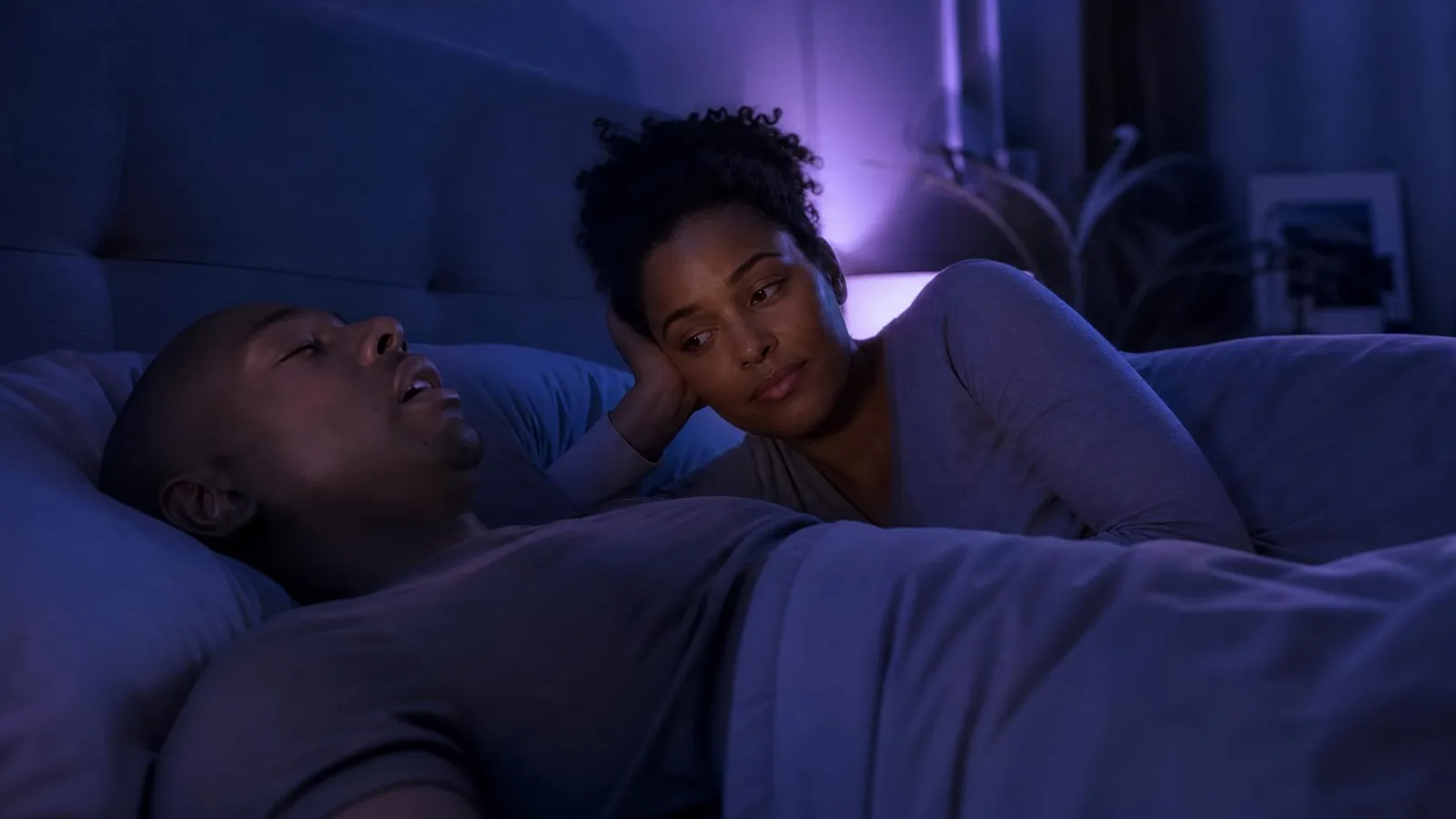
That witness is almost always a bed partner. They are the one who lies awake listening to the snoring stop, then counting the unnerving seconds of silence until you take a gasping breath again. The Cleveland Clinic lists "breathing pauses while asleep" among the symptoms a sleeping partner may be the first to notice. In other words, the most specific item on the whole questionnaire is the one you are least equipped to score alone, and the most likely person to score it for you is sleeping right next to you.
This is the heart of DuoSnore's couple-based approach, and why the test fits so naturally into it. When two people share what they observe, the O stops being a guess and becomes an actual report. Instead of a vague "I think you stopped breathing last night," the partner has a structured place to note what they witnessed, turning anecdote into something closer to a dated record. If you are the exhausted listener trying to make sense of it all, what to do when your partner snores is written for you. The takeaway: apnea hides from the person who has it and reveals itself to the person beside them, so the partner's answer is often the most valuable point on the test.
What should you do with your score?
What you do depends on which band you land in, but the guiding principle is the same throughout: use the number to decide how urgently to act, not as a final answer. A screening score is a signpost, and the destination is always the same when red flags are present, a clinician and, if needed, a sleep study.
Here is a practical way to act on each band:
- Low risk (0–2). Reassuring, but stay alert. If you snore loudly, wake unrefreshed, or a partner ever notices pauses, mention it to a doctor anyway, because no screen is perfect.
- Intermediate risk (3–4). Bring it up at your next appointment. Note any witnessed pauses, daytime sleepiness, morning headaches or night-time urination, as those details help your doctor decide whether to order a sleep study.
- High risk (5–8). Make an appointment specifically to discuss it, and ask directly about a sleep study. The higher your score, the stronger the case for testing.
Whatever your band, certain signs warrant seeing a doctor regardless of the number. If your loud, habitual snoring comes with witnessed pauses in breathing, gasping or choking, the NHS advises getting medical help, because these can signal sleep apnea that is serious if untreated. Other red flags include excessive daytime sleepiness, waking unrefreshed despite enough hours, and frequent morning headaches.
There is good reason not to sit on a high score. Obstructive sleep apnea is both common and badly underdiagnosed: the American Academy of Sleep Medicine reports that roughly 80% of OSA cases in the United States go undiagnosed, even though it is very treatable once identified. Acting on your score is how you close that gap for yourself. The takeaway: let your band set the urgency, watch for the red flags, and let a doctor make the call.
How does DuoSnore use STOP-BANG?
DuoSnore builds STOP-BANG right into the app so that the test, your risk, and your actual nightly data all live in one place. Rather than taking the questionnaire once on a website and forgetting the number, you can complete it in DuoSnore, see your risk band, and then watch how it sits alongside what your nights actually look like. It is the same questionnaire described above, with the same scoring and the same three bands.
The app pairs the questionnaire with an apnea-risk indicator and the measurements that matter. Each night, DuoSnore analyses sound entirely on your device, the audio is never uploaded, and gives you a Snore Score from 0 to 100, your snoring minutes and your peak volume. That turns the vague sense of "I snore a lot" into a trend you can see. According to the Sleep Foundation, sleep apnea affects an estimated 30 million adults in the United States, so having your own data on hand makes a doctor's visit more productive.
Because DuoSnore links two accounts, it directly answers the hardest part of the test. Your partner can help record the observed-apnea evidence you cannot capture alone, so the O is based on what someone actually saw. The one thing the app deliberately does not do is diagnose you: every result, the Snore Score, the risk indicator and the STOP-BANG band, is indicative, not a diagnosis, and DuoSnore is not a medical device. If your score raises questions about the snoring itself, our pillar guide on how to stop snoring covers the evidence-based fixes. The takeaway: DuoSnore turns STOP-BANG from a one-off quiz into a shared, measured part of understanding your sleep, then hands the verdict to a doctor.
Frequently asked questions
What is the STOP-BANG questionnaire?
STOP-BANG is a short, widely used screening questionnaire for obstructive sleep apnea. It has eight yes-or-no questions, and the letters of the name double as a memory aid: Snoring, Tiredness, Observed apnea, Pressure, BMI, Age, Neck and Gender. You score one point for each yes, for a total of 0 to 8. It was designed to flag people who should be evaluated for apnea, not to diagnose it.
How is the STOP-BANG score calculated?
You answer each of the eight questions yes or no and add one point for every yes. The total runs from 0 to 8. A score of 0 to 2 is read as low risk of obstructive sleep apnea, 3 to 4 as intermediate risk, and 5 to 8 as high risk. The questions cover loud snoring, daytime tiredness, witnessed breathing pauses, high blood pressure, a BMI over 35, age over 50, a neck over 40 cm and being male.
What is a high STOP-BANG score?
A score of 5 or higher is considered high risk. At that level the chance of having moderate-to-severe obstructive sleep apnea is meaningfully raised, which is why a high score should prompt a conversation with a doctor about a sleep study. A score of 3 or 4 is intermediate and still worth discussing, especially if a partner has witnessed pauses in breathing, gasping or choking during your sleep.
Is a high STOP-BANG score a diagnosis of sleep apnea?
No. STOP-BANG is a screening tool, not a diagnostic test. A high score means your risk is raised and you should be evaluated, not that you definitely have sleep apnea. The questionnaire is deliberately tuned to catch as many real cases as possible, so it produces some false positives. Only a sleep study, an in-lab polysomnography or a validated home sleep test, can actually confirm or rule out apnea.
Why does STOP-BANG ask whether someone has seen you stop breathing?
Because the breathing pauses of sleep apnea happen while you are asleep, so you usually cannot report them yourself. The O in STOP-BANG, observed apnea, is the one question you often cannot answer alone. A bed partner is frequently the first person to notice the pauses, gasps and choking sounds, which makes them a key witness and is exactly why a couple-based approach to spotting apnea is so useful.
Can I rely on STOP-BANG instead of seeing a doctor?
No. STOP-BANG is a starting point that helps you decide whether to seek medical advice, not a replacement for it. A low score is reassuring but does not guarantee you are apnea-free, and a high score does not confirm apnea. If your snoring comes with witnessed pauses, daytime sleepiness or morning headaches, see a doctor regardless of your score and ask whether a sleep study is appropriate.
Does DuoSnore include the STOP-BANG test?
Yes. The STOP-BANG questionnaire is built into DuoSnore, alongside an apnea-risk indicator, so you can complete it in a couple of minutes and see your risk band next to your tracked snoring data. Because DuoSnore links two accounts, your partner can help answer the observed-apnea question. Everything DuoSnore shows is indicative, not a diagnosis, and the app is not a medical device.
Wellness, not a diagnosis. DuoSnore is not a medical device and this article is not a substitute for professional medical advice. If you have symptoms or any concern about your health or sleep, consult a healthcare professional.