Snoring vs Sleep Apnea: How to Tell the Difference (2026)
Snoring vs Sleep Apnea: How to Tell the Difference (2026)
Almost everyone who worries they might have sleep apnea starts from the same place: loud snoring. But snoring and sleep apnea are not the same condition, and confusing the two cuts both ways. Most snorers do not have apnea and do not need to panic, while some people brush off snoring that is actually a warning sign worth acting on. This guide draws a clear line between the two, gives you a side-by-side comparison of the symptoms, walks through the STOP-BANG screening test, and explains why the person sleeping next to you is often the first to spot the real problem.
DuoSnore is a wellness and self-tracking app, not a medical device. Nothing here is a diagnosis. The goal is to help you understand your snoring and arrive at a doctor's appointment already informed.
What is the difference between snoring and sleep apnea?
The short version: snoring is a sound, while obstructive sleep apnea is a breathing disorder that often produces that sound. Snoring happens when the muscles lining your throat relax during sleep and the soft tissues, the soft palate, uvula and tongue base, vibrate as air squeezes past them. It can be loud and annoying, but on its own it is usually harmless. The airway is narrowed, not blocked, and you keep breathing normally the whole time.
Obstructive sleep apnea (OSA) is what happens when that narrowing tips over into repeated collapse. The airway closes so far that airflow stops for ten seconds or more, your blood oxygen dips, and your brain briefly jolts you out of deep sleep to reopen the airway, often with a loud gasp or snort. Then you drift back down and it happens again, sometimes dozens of times an hour, all night, usually without you remembering any of it.
So the defining difference is not how loud the noise is. It is whether your breathing actually stops. According to the Sleep Foundation, snoring is the most common symptom of obstructive sleep apnea, but not everyone who snores has it, and snoring only signals apnea when it is interrupted by episodes of gasping, choking or pauses in breathing. That single distinction, continuous airflow versus repeated stops, is the heart of the whole question.
How do you recognise sleep apnea?
You recognise it by looking past the volume and watching for a cluster of telltale signs, both at night and during the day. Simple snoring is a fairly steady, rhythmic sound that rises and falls with your breath. Apnea breaks that rhythm: the sound stops dead for several seconds during a pause, then resumes with a sudden gasp, snort or choke as the airway reopens. Where snoring is monotonous, apnea is interrupted.
The daytime picture matters just as much. Because the brain keeps surfacing to restart breathing, sleep is fragmented even if total hours look normal, so apnea drains your energy in a way that ordinary snoring does not. People with untreated OSA often wake unrefreshed, feel sleepy or foggy during the day, get morning headaches, wake with a dry mouth or sore throat, and find themselves up to urinate at night. Simple snoring, by contrast, rarely wrecks the snorer's own daytime function.
The clearest way to see all of this is side by side. The table below contrasts simple (primary) snoring with obstructive sleep apnea on the features that actually separate them.
| Feature | Simple (primary) snoring | Obstructive sleep apnea |
|---|---|---|
| Sound pattern | Continuous, steady, rhythmic | Interrupted by pauses, then loud gasps, snorts or choking |
| Breathing pauses | None | Repeated stops in breathing of 10 seconds or more |
| Daytime sleepiness | Usually none | Common, sometimes severe |
| Morning headaches | Rare | Frequent |
| Refreshing sleep | Usually feels rested | Wakes unrefreshed despite enough hours |
| Night urination (nocturia) | Uncommon | Often increased |
| Mood and irritability | Usually unaffected | Irritability, low mood, poor concentration |
| Witness needed | No | Yes, partner usually sees the pauses first |
| Health risk | Low on its own | High if untreated (heart, blood pressure, stroke) |
If your snoring sits entirely in the left column, it is most likely ordinary snoring. If items from the right column keep showing up, especially witnessed pauses plus daytime sleepiness, that is the combination that warrants a closer look. As the Cleveland Clinic puts it, snoring does not necessarily mean you have sleep apnea, but if it is loud, disruptive or frequent it may be a symptom of obstructive sleep apnea. The takeaway: judge the pattern and the daytime cost, not the decibels.
Is all loud snoring sleep apnea?
No, and this is the single most important misconception to clear up. Loud snoring is extremely common, far more common than apnea, and most of it is not dangerous. According to the Cleveland Clinic, roughly 40% of adult men and 24% of adult women are habitual snorers, yet only a fraction of them have obstructive sleep apnea. Volume alone simply does not decide the matter; plenty of people snore loudly for years with perfectly normal breathing.
What turns ordinary loud snoring into a red flag is the company it keeps. Loud snoring becomes concerning when it is broken up by pauses in breathing, gasping or choking, and when it travels alongside daytime sleepiness, morning headaches or unrefreshing sleep. A person who snores like a freight train but wakes up refreshed, feels alert all day and never stops breathing is in a very different situation from someone whose snoring is punctuated by silent gaps and who can barely keep their eyes open at 3 p.m.
That said, loud habitual snoring is still the most common early signal of apnea, so it is worth tracking rather than ignoring. The point is not to panic at noise, but to notice whether the noise comes with the rest of the pattern. The takeaway: loud snoring is a reason to pay attention, not an automatic diagnosis.
What is the STOP-BANG test?
STOP-BANG is one of the most widely used screening questionnaires for obstructive sleep apnea, and it is a useful way to put a number on your risk before you ever see a doctor. It is deliberately simple: eight yes-or-no questions, one point each, with the letters of the name doubling as a memory aid for what each item asks.
Here is what each letter stands for:
- S — Snoring. Do you snore loudly, loud enough to be heard through a closed door or to bother your partner?
- T — Tiredness. Do you often feel tired, fatigued or sleepy during the daytime?
- O — Observed apnea. Has anyone observed you stop breathing, gasp or choke during your sleep?
- P — Pressure. Do you have, or are you being treated for, high blood pressure?
- B — BMI. Is your body mass index more than 35 kg per square metre?
- A — Age. Are you older than 50?
- N — Neck. Is your neck circumference more than 40 cm (about 16 inches)?
- G — Gender. Are you male?
You score one point for each yes, for a total of 0 to 8. A score of 0 to 2 suggests low risk, 3 to 4 suggests intermediate risk, and 5 to 8 suggests high risk of obstructive sleep apnea. The tool is intentionally tuned to catch as many real cases as possible: a 2021 systematic review and meta-analysis found that a STOP-BANG score of 3 or higher had a pooled sensitivity of about 88% for moderate OSA and 93% for severe OSA. High sensitivity is exactly what you want in a screen, but it comes at the cost of false positives, which is why a raised score means get evaluated, not you definitely have apnea.
This is one of the features built into DuoSnore. The app includes the STOP-BANG questionnaire so you can complete it in a couple of minutes and see your risk band alongside your tracked snoring data. To be completely clear: that result is indicative, not a diagnosis. It is a structured way to decide whether a conversation with a doctor is warranted, nothing more. The takeaway: STOP-BANG turns a vague worry into a number you can act on, while staying firmly on the screening side of the line.
Why is the partner the key witness?
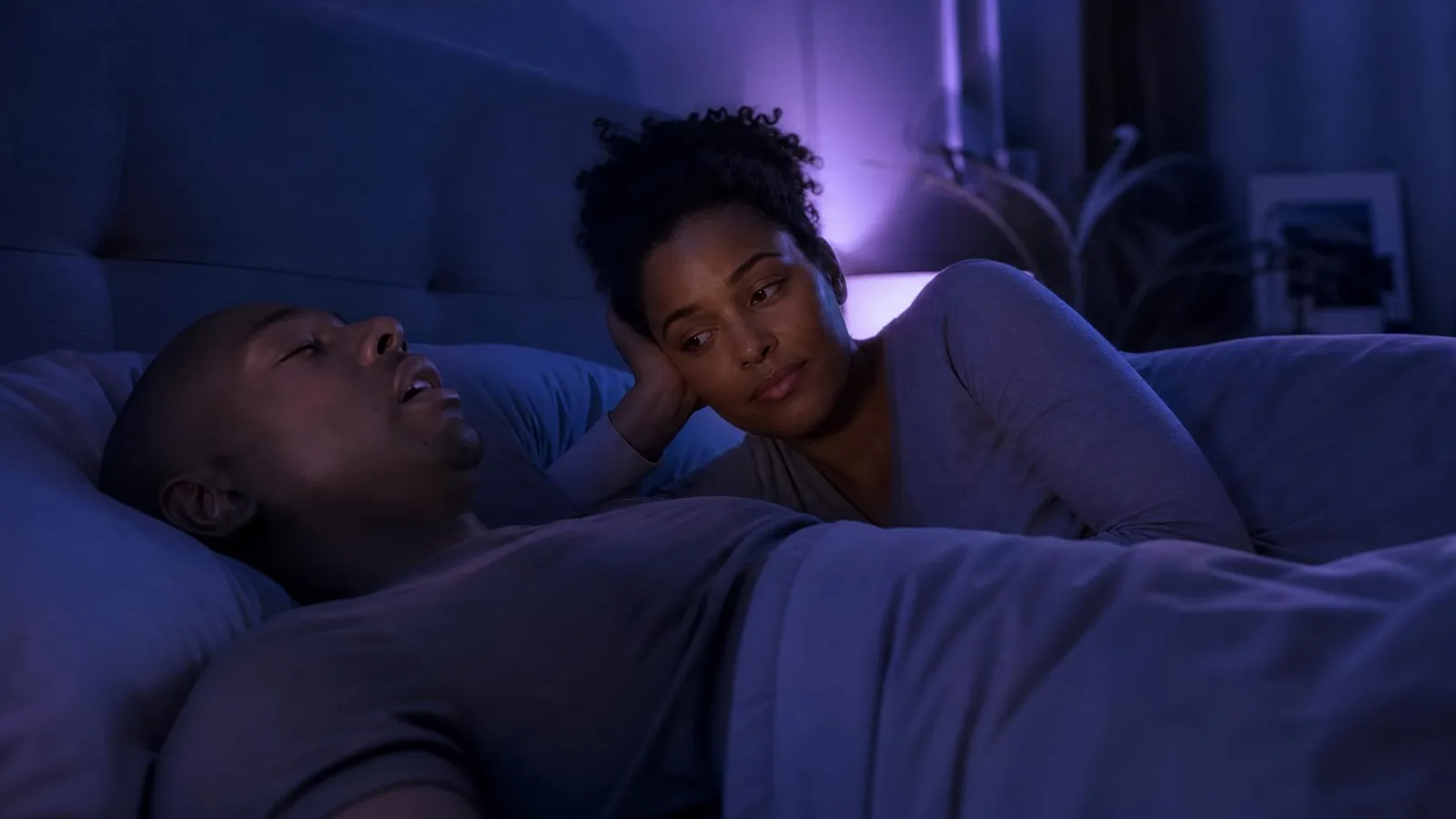
Because the most important evidence happens while you are unconscious, and someone else has to see it. This is the quiet truth at the centre of sleep apnea, and it is exactly where a couple-focused approach earns its keep. The pauses in breathing, the sudden gasps, the choking sounds, the long unnerving silences, you sleep through all of it. The person lying next to you does not.
Think about which STOP-BANG item is hardest to answer alone: the O, observed apnea. You genuinely cannot report whether you stop breathing, because you are asleep when it happens. Your partner, on the other hand, is often the one who lies awake counting the seconds until you take a breath again. That is why obstructive sleep apnea is so frequently first noticed not by the patient but by their bed partner, and why the NHS specifically advises seeing a doctor when snoring comes with breathing that stops and starts during sleep, the kind of thing a witness reports.
This is the core idea behind DuoSnore. Two people link their accounts so the snorer's nightly recordings, Snore Score and snoring minutes are visible to both, and the partner has a structured place to note what they observe, including possible pauses. Instead of a half-remembered "I think you stopped breathing last night," you get something closer to a shared, dated record. The partner becomes an informed witness rather than an anxious bystander. The takeaway: apnea hides from the person who has it and reveals itself to the person beside them, so two sets of eyes beat one.
Why is untreated sleep apnea dangerous?
Because every breathing pause is a small physiological stress, and hundreds of them a night, year after year, add up. When the airway collapses, oxygen drops and the body responds with a surge of stress hormones and a spike in blood pressure to force you awake and reopen the airway. Doing that repeatedly all night keeps the cardiovascular system on high alert when it should be resting and recovering.
The downstream risks are well documented. According to the American Heart Association, obstructive sleep apnea has been linked to higher rates of high blood pressure, stroke and coronary artery disease, and it can contribute to heart failure. Beyond the heart, untreated OSA is associated with type 2 diabetes and with the kind of severe daytime sleepiness that makes drowsy driving genuinely dangerous. None of this is meant to alarm every snorer, most snorers are fine, but it explains why ruling apnea in or out actually matters.
There is a genuinely reassuring flip side, though: apnea is very treatable once it is identified. The problem is that it so often goes unrecognised. The Sleep Foundation notes that sleep apnea affects an estimated 30 million adults in the United States, and the AASM and other bodies estimate that a large majority of cases remain undiagnosed. That gap between how common apnea is and how rarely it is caught is precisely why noticing the signs early is worth the effort. The takeaway: the danger of apnea comes from leaving it untreated, not from it being untreatable.
When should you see a doctor?
You should see a doctor when your snoring carries the red flags of obstructive sleep apnea, rather than waiting for something dramatic to force the issue. The decision is simpler than it sounds, because the warning signs cluster together in a recognisable pattern.
Make an appointment if you have loud, habitual snoring plus one or more of the following:
- Witnessed pauses in breathing during sleep, or you wake gasping or choking.
- Excessive daytime sleepiness, or falling asleep when you do not mean to.
- Waking unrefreshed despite spending enough hours in bed.
- Frequent morning headaches.
- Trouble concentrating, memory lapses, or new irritability and low mood.
- Getting up to urinate several times a night without another clear cause.
If those ring true, the next step is a conversation with a doctor about a sleep study. A sleep study, whether an in-lab polysomnography or a validated home sleep test, measures your breathing, oxygen levels and sleep stages overnight, and it is the only way to confirm or rule out apnea and grade its severity. A screening result, including a high STOP-BANG score or anything DuoSnore shows you, is a reason to seek that evaluation, never a replacement for it. The NHS is explicit that breathing stopping and starting during sleep is a reason to get medical advice rather than to keep self-managing. The takeaway: if the red-flag pattern fits, let a clinician and a sleep study settle it.
How can DuoSnore help you spot the signs?
DuoSnore is designed to help you and your partner notice the pattern early and bring real information to a doctor, while staying clearly on the right side of the medical line. It does this in a few connected ways, all of them about observation, not diagnosis.
First, it measures what is otherwise invisible. Each night, the app analyses sound entirely on your device, the audio is never uploaded, and gives you a Snore Score from 0 to 100, your snoring minutes, your peak volume in decibels and an intensity reading. That turns vague impressions into a trend you can actually see. Second, it adds an apnea-risk indicator and the built-in STOP-BANG questionnaire, so the signs the table above describes are gathered in one place instead of half-remembered. Third, because it links two accounts, your partner can record what they witness, the pauses, the gasps, exactly the observed-apnea evidence you cannot capture alone.
The one thing it deliberately does not do is diagnose you. Everything DuoSnore shows, the score, the trend, the risk indicator, the STOP-BANG band, is indicative, not a diagnosis, and it is not a medical device. Its job is to help you decide, with your partner and your data, whether to book that appointment, and then to make the appointment more productive when you do.
If you want to go deeper, start with our pillar guide on how to stop snoring, which covers the evidence-based fixes for ordinary snoring. If you are unsure whose snoring is even the issue, see who is snoring, me or my partner. And if you are the exhausted listener trying to help, what to do when your partner snores is written for you. The takeaway: measure together, watch for the red flags, run the STOP-BANG, and let a doctor make the call.
Frequently asked questions
What is the difference between snoring and sleep apnea?
Snoring is the steady sound of a partly narrowed airway vibrating as you breathe, and on its own it is usually harmless. Obstructive sleep apnea is when that airway repeatedly collapses, so breathing actually pauses for seconds at a time, followed by a gasp or snort. The defining difference is those breathing pauses, plus daytime sleepiness and unrefreshing sleep.
Is all loud snoring sleep apnea?
No. Most people who snore do not have sleep apnea, and plenty of snoring is simply loud without being dangerous. Snoring only points to apnea when it is interrupted by witnessed pauses in breathing, gasping or choking, and is paired with daytime sleepiness, morning headaches or unrefreshing sleep. Volume alone does not decide it; the pattern and the daytime symptoms do.
How can I tell if my snoring is sleep apnea?
Watch for the apnea pattern rather than the volume. The clearest signs are pauses in breathing, gasping or choking awake, waking unrefreshed, daytime sleepiness, morning headaches and needing to urinate at night. A bed partner usually notices the pauses first. A screening tool like STOP-BANG can flag your risk, but only a sleep study can confirm or rule out apnea.
What is the STOP-BANG test?
STOP-BANG is a widely used eight-item screening questionnaire for obstructive sleep apnea. The letters stand for Snoring, Tiredness, Observed apnea, high blood Pressure, BMI over 35, Age over 50, Neck over 40 cm, and male Gender. You score one point for each yes. A score of 0 to 2 suggests low risk, 3 to 4 intermediate risk, and 5 to 8 high risk. It is a screen, not a diagnosis.
Why is untreated sleep apnea dangerous?
Because each pause in breathing stresses the heart and starves the body of oxygen, night after night. Untreated obstructive sleep apnea is linked to higher rates of high blood pressure, stroke and coronary artery disease, as well as type 2 diabetes and dangerous daytime sleepiness behind the wheel. The reassuring part is that it is very treatable once it is diagnosed.
Can my partner help spot sleep apnea?
Yes, and they are often the first to notice it. You are asleep when the breathing pauses, gasps and snorts happen, so you usually cannot report them. Your bed partner can. That is why apnea is so often discovered by the person lying next to the snorer, and why tracking and observing the signs together is one of the most useful things a couple can do.
When should I see a doctor about snoring?
See a doctor if your snoring is loud and habitual and comes with witnessed pauses in breathing, gasping or choking at night, daytime sleepiness, morning headaches or unrefreshing sleep. These are the red flags for obstructive sleep apnea. A doctor can arrange a sleep study, which is the only way to confirm a diagnosis and start treatment.
Wellness, not a diagnosis. DuoSnore is not a medical device and this article is not a substitute for professional medical advice. If you have symptoms or any concern about your health or sleep, consult a healthcare professional.