Sleep Divorce: Stats, Pros and Cons, and the Data-First Alternative (2026)
Sleep Divorce: Stats, Pros and Cons, and the Data-First Alternative (2026)
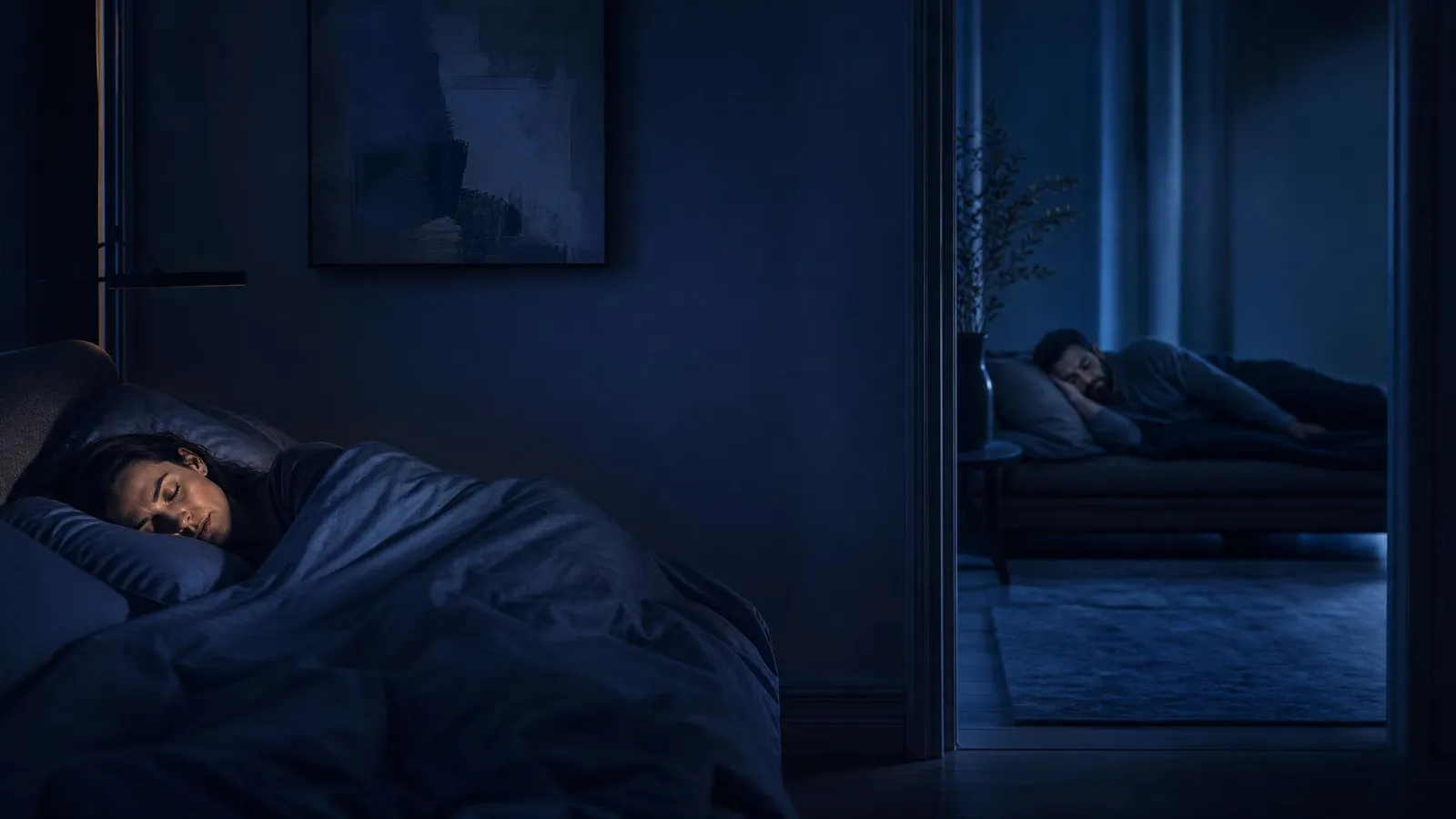
At some point, almost every couple who shares a bed with a snorer asks the same quiet question: should we just sleep in separate rooms? That arrangement now has a name, a "sleep divorce," and it is far more common and far less dramatic than it sounds. This guide lays out what a sleep divorce actually is, the real numbers behind the trend, and the honest pros and cons. Then it covers the part most articles skip: separate rooms do not fix snoring, they just move it, and there is a measurable alternative worth trying first.
DuoSnore is a wellness app, not a medical device, and this is general information, not a diagnosis.
What is a sleep divorce?
A sleep divorce is when two partners deliberately sleep in separate beds, or separate rooms, to get better rest. Despite the dramatic name, it has nothing to do with legal divorce or a relationship in trouble. It is a sleep arrangement, not a relationship status, and it can be occasional, on bad nights only, or a permanent setup. The term went mainstream because more couples started talking openly about something they used to hide.
The reasons are usually mundane and physical rather than emotional: one partner snores, the two run on different schedules, one is a restless sleeper, or a new baby has wrecked everyone's nights. Among these, snoring is one of the most common drivers, because it is loud, nightly, and impossible to ignore from a few inches away. Sleep specialists increasingly treat the arrangement as a legitimate tool rather than a failure, and the American Academy of Sleep Medicine frames it as a practical way to protect sleep. The key idea to hold onto is that a sleep divorce describes where you sleep, not how much you love each other.
How common is sleeping in separate bedrooms?
Much more common than most people assume, which is exactly why the topic stopped being taboo. In a 2023 survey by the American Academy of Sleep Medicine, more than a third of US adults said they occasionally or consistently sleep in another room to accommodate a bed partner. The same survey of 2,005 adults found a clear generational split: 43% of millennials reported doing it, compared with 33% of Generation X, 28% of Generation Z, and 22% of baby boomers. Sleeping apart, it turns out, is most embraced by people in the thick of careers and young families.
A more recent AASM survey put the overall figure at around 31% and found the practice peaks among adults aged 35 to 44, at 39%, while only 18% of those 65 and older do it. The two numbers differ slightly because surveys word the question differently, but the direction is consistent and unambiguous: a large minority of couples already sleep apart at least some of the time, and the behavior clusters in the busiest, most sleep-starved life stages. If you have wondered whether wanting your own room makes you unusual, the data says clearly that it does not.
Why is the sleep divorce trend rising?
Because sleep itself has been culturally promoted from a luxury to a health priority, and couples are acting on that. For decades, sharing a bed was treated as non-negotiable proof of a healthy marriage, and admitting you slept better apart felt like a confession. That stigma is fading fast as the science on sleep deprivation, mood, focus, and long-term health becomes common knowledge. People are simply less willing to sacrifice a third of their rest out of tradition.
Three forces are pushing the trend together. First, awareness: the harms of fragmented sleep are now widely understood, so partners feel justified protecting it. Second, openness: social media and frank reporting have made separate sleeping a normal thing to discuss rather than hide. Third, the snoring problem is not going away, and in some cases is worsening alongside rising rates of the things that aggravate it. There is also a practical accelerant, as more couples work irregular hours and live in homes with a spare room available, the option is simply easier to act on than it was a generation ago. The trend is real and rooted in genuine benefit. The important caveat, which the next sections unpack, is that choosing separate rooms because of snoring solves the listener's problem while leaving the snorer's airway exactly as it was.
What are the pros and cons of a sleep divorce?
The honest answer is that it genuinely helps with some things and genuinely costs you others, and a good decision weighs both rather than pretending either side does not exist. On the benefit side, the gain in sleep is not trivial. According to the Sleep Foundation, adults who sleep separately average roughly 37 extra minutes of sleep per night compared with those who share a bed, and a majority who try it report better sleep quality. More uninterrupted sleep means better mood, sharper focus, and often less of the irritability that chronic exhaustion breeds, which can actually protect a relationship rather than harm it.
The costs are mostly about connection, not sleep. Sharing a bed offers easy physical closeness, the small talk before sleep, and a sense of togetherness that separate rooms can quietly erode if you let them. The Sleep Foundation also notes that a meaningful share of couples who sleep apart later return to a shared bed, often simply because they miss each other. And there is a deeper cost specific to snoring: moving rooms treats the noise, not the airway, so a potential health signal goes unexamined. Here is how the trade-off looks when you separate masking the problem from treating its cause.
| Approach | What it does for the listener | What it does for the snorer | Root cause addressed? | Effect on closeness |
|---|---|---|---|---|
| Separate rooms (mask the problem) | Quieter, more sleep right away | Nothing; still snoring | No, fully unaddressed | Reduced if it becomes the default |
| Earplugs / white noise | Partial relief, stays in same bed | Nothing | No | Neutral |
| Measure and reduce together (treat the cause) | Less noise as snoring drops | Snoring actually decreases | Yes, triggers identified | Strengthened; it becomes a shared project |
| Doctor visit if apnea suspected | Peace of mind | Diagnosis or all-clear | Yes, medically | Strengthened |
The takeaway is not that a sleep divorce is good or bad, but that it is a symptom-management tool. Used to recover while you fix the underlying snoring, it is sensible. Used as a permanent way to never deal with the cause, it leaves real value, and possibly real health information, on the table.
Does sleeping apart fix snoring?
No, and this is the single most important thing to understand before you move bedrooms over snoring. Sleeping in a separate room changes one thing only: the distance between the snore and your ear. The snorer's airway is exactly as narrow, as vibration-prone, and as obstructed as it was the night before. They still snore every bit as loudly, you simply are not there to hear it. Relocating is noise management for the listener, not treatment for the snorer.
That distinction matters because loud, habitual snoring can be more than an annoyance. According to the American Academy of Sleep Medicine, if one partner's loud snoring is what drives a couple into separate rooms, that partner should talk to a doctor about obstructive sleep apnea, a condition linked in the medical literature to high blood pressure and heart problems. When you move to another room, the very person best placed to notice the warning signs, the bed partner, is no longer in the room to witness them. So separate sleeping can have the unintended effect of hiding a potential medical issue at exactly the moment it most needs attention. The takeaway is blunt: separate rooms silence the symptom for you and silence the alarm for both of you.
What's the alternative to a sleep divorce?
Measure the problem before you decide to live with it. If snoring is the reason you are considering separate rooms, you are about to make a significant relationship decision based on a vague, sleep-deprived impression of "they snore a lot." The data-first alternative is to replace that impression with actual evidence: how loud the snoring really is, how often it happens, what makes it worse, and whether simple changes bring it down. With real numbers, you can make a genuine choice instead of a desperate retreat.
This is the gap DuoSnore is built to fill, as a wellness tool rather than a medical device. It is designed for couples specifically, "two nights, one screen," so both partners can see the same data instead of arguing about whose memory of the night is right. Each morning you get a Snore Score that turns last night into a single comparable number, and a Factors view that reveals personal triggers, for example showing "alcohol +47% snoring" from the snorer's own recorded nights. Linking two accounts lets a couple compare nights side by side and watch the trend together. The point is not to win the argument; it is to find out whether the snoring is reducible before you conclude that sleeping apart is the only option. Often it is reducible, and often the couple keeps the bed. To go deeper on which methods actually work, see our pillar guide on how to stop snoring.
How can a couple reduce snoring together?
By treating it as a shared, measurable project rather than one person's nightly crime. The most effective changes are unglamorous and well established, and they work far better when both partners are bought in and tracking the result. Doing it together also removes the blame dynamic that makes snoring such a charged topic, because the conversation shifts from "you kept me up" to "the score dropped when you slept on your side."
Here is the realistic playbook, roughly in order of effort:
- Side-sleeping — rolling off the back onto the side often reduces or stops positional snoring the very first night.
- Clear the nose — treating congestion and allergies restores quiet nasal breathing instead of forcing mouth breathing.
- Time the alcohol — avoiding alcohol in the few hours before bed prevents the throat from over-relaxing.
- Throat exercises — a consistent 30-day anti-snoring program of short daily exercises can strengthen the airway muscles over a few weeks.
- Track everything — logging each night shows which changes actually move the number, so you keep what works and drop what does not.
A first step many couples find clarifying is simply figuring out who is snoring, you or your partner, since both people often contribute and neither remembers it. If, despite consistent effort, the snoring stays loud and habitual, or comes with gasping or pauses in breathing, that is the moment to see a doctor rather than just change rooms. And if you do choose separate sleeping in the end, you will have chosen it from data, as an informed decision, instead of surrendering to a problem you never measured. DuoSnore is a wellness and self-tracking tool, not a diagnosis, but it can turn "we can't sleep together anymore" into "let's see if we can fix this first." For the partner on the receiving end, our guide on what to do when your partner snores covers the night-by-night tactics in detail.
Frequently asked questions
What is a sleep divorce?
A sleep divorce is when a couple chooses to sleep in separate beds, or separate rooms, on purpose to get better rest. It has nothing to do with actual divorce or a failing relationship. Sleep specialists describe it as a practical arrangement many healthy couples use to cope with snoring, different schedules, or restless sleep.
How common is sleeping in separate bedrooms?
Very. In an American Academy of Sleep Medicine survey, more than a third of US adults said they occasionally or consistently sleep in another room to accommodate a partner. A later AASM survey put the figure around 31 percent. It is most common among adults aged 35 to 44 and among millennials, and least common among older adults.
Does sleeping in separate rooms fix snoring?
No. Sleeping apart only moves the noise away from your ear; it does nothing to the airway that is causing the snoring. The snorer still snores, and any underlying issue, including possible sleep apnea, goes unmeasured and untreated. Separate rooms mask the symptom for the listener but leave the actual cause completely unaddressed.
Is a sleep divorce healthy or a sign of a failing relationship?
On its own it is neither unhealthy nor a red flag. Protecting sleep can reduce resentment and improve mood, which often helps a relationship. The risk is using separate rooms to permanently avoid a fixable problem like snoring, and losing the closeness of a shared bed without ever trying to address why you sleep apart.
What's the alternative to a sleep divorce?
Measure the problem before you give up the bed. If snoring is the reason, track it objectively for a few nights to see how loud and how frequent it really is, identify the triggers, and work through proven changes together. Many couples reduce snoring enough to keep sharing a bed, or choose separate rooms as an informed decision rather than a surrender.
How can a couple reduce snoring together?
Start with side-sleeping, clearing the nose, and avoiding late alcohol, then add throat exercises over a few weeks. Doing it as a team, with shared tracking, turns a nightly argument into a measurable project. Tools like DuoSnore let both partners see the nightly snore score and what moves it, so progress is visible and motivating rather than a source of blame.
Can you love each other and still sleep in separate beds?
Absolutely. Plenty of close, committed couples sleep apart and stay deeply connected by protecting intimacy in other ways, such as a shared wind-down routine or time in bed together before separating. The arrangement only becomes a problem if it quietly replaces connection or hides an untreated health issue rather than being a conscious, shared choice.
Wellness, not a diagnosis. DuoSnore is not a medical device and this article is not a substitute for professional medical advice. If you have symptoms or any concern about your health or sleep, consult a healthcare professional.
Related articles

Snoring Decibels: How Loud Is Too Loud? (2026)
Most snoring falls between 40 and 60 decibels, and above 60 it is louder than a normal conversation. Here is the scale sleep medicine uses, what it does to the person beside you, and why your own perception cannot be trusted.

Who Is Snoring: Me or My Partner? How to Finally Know (2026)
Not sure who snores in your bed? Here are the real ways to find out, ranked and compared, plus why the snorer almost never hears themselves and how to settle it for good.